



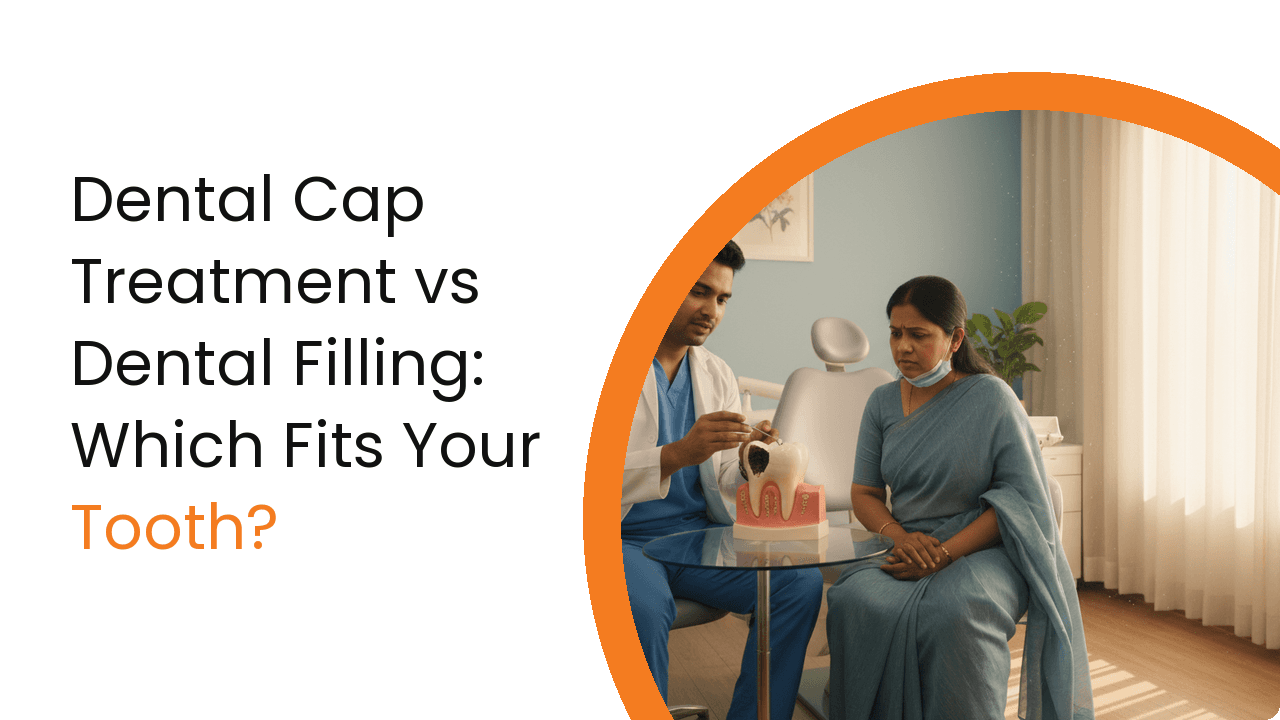
Dental cap treatment vs dental filling becomes urgent when a tooth is chipped, deeply decayed, or weakened after treatment. You may be unsure whether a smaller repair can protect it, or whether a cap is necessary. The direct answer depends on the amount of healthy tooth structure left. A filling suits a small to moderate cavity. A cap covers and protects a tooth with larger damage, a fracture, deep decay, or major weakening. We assess this with examination and imaging before recommending either option. Eledent Dental Hospitals brings 20+ years of experience, 30,000+ smiles restored, and specialist care within a NABH-accredited hospital. Read on for the differences in coverage, materials, cost, procedure, and delay risks, so you can ask better questions during your dental consultation.
Key takeaways
- Fillings repair smaller areas, while caps cover and protect teeth with substantial structural loss.
- The remaining healthy tooth structure usually guides the choice between a filling and a cap.
- Dental Fillings starts from ₹800 at Eledent Dental Hospitals.
- A delayed restoration can allow cracks or decay to progress and make treatment more complex.
- Outcomes depend on individual case and oral health status.
What Is The Difference Between A Dental Cap And A Filling?
A dental cap, also called a dental crown, is a tooth-shaped restoration placed over a damaged tooth to restore its shape, strength and function. A filling replaces a smaller amount of tooth structure lost to decay or damage.
| Feature | Dental Filling | Dental Cap |
|---|---|---|
| Coverage | Fills the damaged area inside the tooth. | Covers the visible tooth above the gum line. |
| Typical use | Small to moderate cavities and limited damage. | Large fractures, deep decay, or weakened teeth. |
| Main aim | Restore the missing section while preserving more tooth structure. | Protect the remaining tooth from chewing forces. |
Our assessment focuses on how much strong tooth remains, not simply how large the cavity looks. A small repair may suit a stable tooth. A heavily weakened tooth may require full coverage.
For focused information about Dental Fillings, review the treatment details before your appointment.
When Is A Dental Filling Suitable?
A dental filling is usually suitable when decay or damage affects a limited part of the tooth and enough healthy structure remains.
Situations That May Suit A Filling
- Small To Moderate Cavity: A filling can replace tooth structure removed during decay treatment.
- Limited Chipping: A small chip may be repaired when the remaining tooth is stable.
- Tooth Preservation: A filling generally requires less removal of healthy tooth structure than a cap.
Fillings may use composite resin, silver amalgam, or glass ionomer. Your dentist selects the material after checking the tooth's position, bite, appearance, and moisture control.
At Eledent Dental Hospitals, Dental Fillings starts from ₹800. The final recommendation depends on the tooth examined, the material selected, and the extent of repair.
Our Dental Cap Treatment page explains when full coverage may be considered after assessment.
When Is A Dental Cap More Suitable?
A dental cap may be more suitable when a tooth has lost substantial structure, developed a larger fracture, or needs protection after significant treatment.
| Tooth Situation | Why A Cap May Be Considered |
|---|---|
| Large fracture | Full coverage can support the remaining walls and chewing surface. |
| Deep decay | More tooth structure may be missing than a filling can safely replace. |
| Weakened tooth | Coverage may reduce exposure of fragile remaining structure to chewing forces. |
| After root canal treatment | A cap may protect a treated tooth when its structure has become significantly compromised. |
Caps can be made from porcelain, zirconia, metal alloys, or ceramic. We discuss appearance, function, bite, and the remaining tooth before selecting a suitable option.
Patients comparing branches can review Dental Cap Treatment in Manikonda, which follows the same clinical planning approach.
What Happens If A Filling Or Dental Cap Is Delayed?
Delaying a needed restoration can allow decay, cracks, or weakened tooth structure to progress, making later treatment more complex.
A small cavity may enlarge and involve deeper layers of the tooth. A cracked tooth may lose another piece during chewing. If the remaining structure becomes too weak, a filling may no longer provide enough support.
Delay does not mean a cap will always be required. Only an examination and suitable imaging can show whether the tooth remains restorable with a smaller repair.
If swelling, persistent sensitivity, or a broken restoration appears, arrange a qualified dental assessment. Our guide to Dental Abscess Treatment vs Tooth Extraction: Which Is Right? may help explain why swelling needs timely review.
How Do Cost And Treatment Steps Compare?
Dental Fillings starts from ₹800, while a cap has no listed starting price here because its cost depends on material, preparation, and tooth condition.
| Stage | Filling | Cap |
|---|---|---|
| Consultation | Examination identifies the cavity or limited defect. | Examination assesses cracks, bite, and remaining structure. |
| Imaging | X-ray or CBCT may be considered when depth is unclear. | Imaging may help assess roots, fractures, and supporting structure. |
| Procedure | Decay is removed, then the space is filled and shaped. | The tooth is prepared, scanned or measured, and restored with a custom cap. |
| Aftercare | Bite and sensitivity are checked after placement. | Bite, fit, margins, and comfort are checked after placement. |
Our team may use CBCT imaging when three-dimensional views are clinically useful. CEREC CAD-CAM technology can support digital restoration workflows in suitable cases.
Ask about payment options or EMI availability during your consultation. Clear planning helps you understand the recommended treatment before proceeding.
For another branch option, Dental Cap Treatment in Banjara Hills follows the same diagnosis and planning principles.
Which Option Should You Discuss With A Dentist?
The suitable option depends on the remaining tooth structure, decay depth, fracture pattern, bite, and oral health status.
A filling may conserve more healthy structure when the defect is limited. A cap may offer broader protection when the tooth is substantially weakened. Neither option should be selected from symptoms alone.
- Bring Your Symptoms: Mention sensitivity, chewing discomfort, food trapping, or a recent break.
- Ask About Imaging: Confirm whether an X-ray or CBCT scan is needed for treatment planning.
- Discuss Materials: Ask how appearance, chewing load, and tooth position affect the restoration.
- Clarify Aftercare: Ask about bite checks, cleaning around the restoration, and follow-up.
Our specialist team includes implantologists, orthodontists, endodontists, and oral surgeons. We coordinate care when a damaged tooth needs more than one area of expertise.
You can also review our Dental erosion treatment information when surface loss may be part of the concern.
A filling generally suits a smaller defect with enough strong tooth remaining. A cap covers more of the tooth when fracture, deep decay, or weakness reduces its support. Dental Fillings starts from ₹800, while cap costs depend on material and case planning. Outcomes depend on individual case and oral health status. Call Eledent Dental Hospitals on +917799639994 to arrange an assessment and discuss the appropriate restoration with a qualified dentist.
FAQs
Is a dental cap better than a filling?
A dental cap is not automatically better than a filling. A filling may suit limited damage, while a cap may suit a tooth with substantial weakening, deep decay, or a larger fracture.
What is the starting price for Dental Fillings?
Dental Fillings starts from ₹800 at Eledent Dental Hospitals. The final recommendation and cost depend on the tooth, material, and extent of repair.
Can a filling be used instead of a dental cap?
A filling may replace a cap in suitable cases when enough strong tooth structure remains. A qualified dentist must assess decay depth, cracks, bite, and restoration support first.
Is a dental cap needed after root canal treatment?
A dental cap may be considered after root canal treatment when the tooth has significant structural weakness. The need depends on the remaining tooth structure and clinical assessment.
What happens if I delay a dental cap?
A weakened tooth left without suitable protection may fracture further or develop deeper decay. Delay can make restoration more complex, although the correct option still requires an examination.
