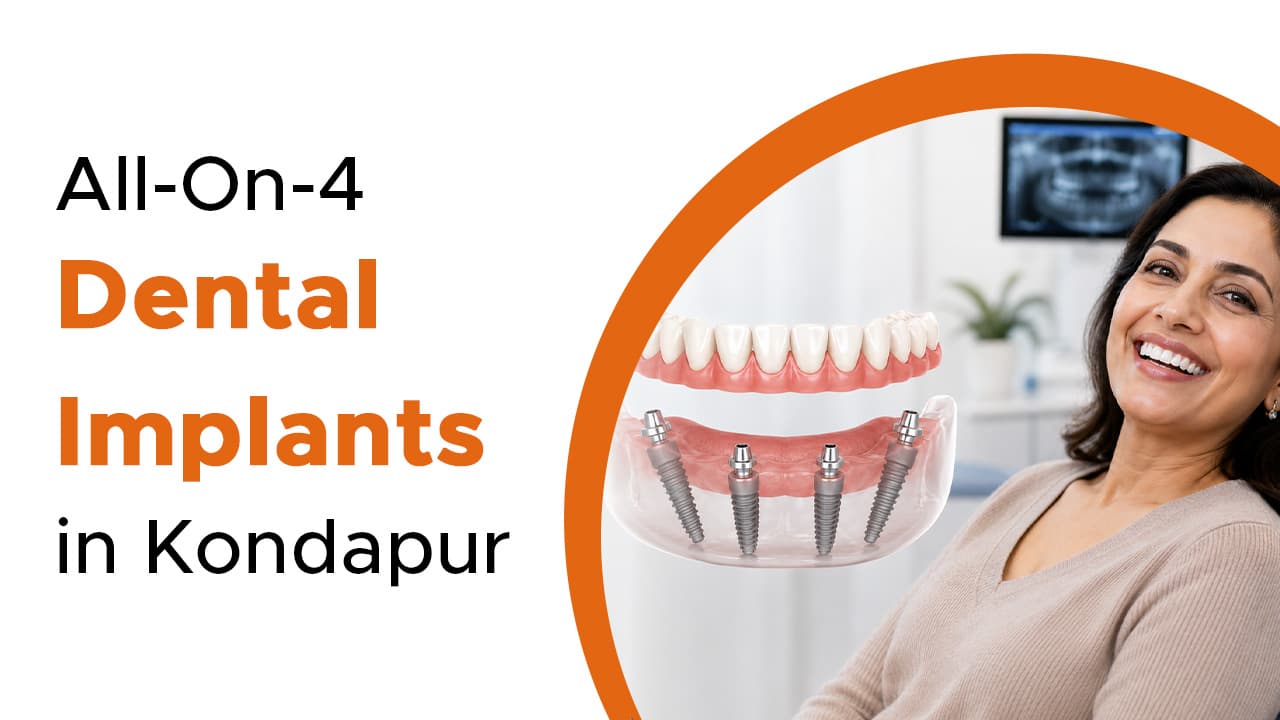
All-on-4 dental implants replace a full arch of missing or failing teeth using four implants placed in the jaw, two at the front, two at the back at an angle. It's a fixed solution, not a removable one, and for many patients dealing with significant tooth loss, it's the most practical route.
At Eledent Dental Hospitals, All-on-4 cases are handled by implantologists and not general dentists. Every case begins with a CBCT scan. The treatment plan follows what the scan shows.
We work with patients from Kondapur, Madhapur, Gachibowli, Miyapur and Hafeezpet dealing with multiple failing teeth, people who have worn dentures for years and want something fixed. This blog explains what All-on-4
dental implants in Kondapur, Hyderabad involves, what the CBCT assessment tells us before surgery, and what aftercare looks like once treatment is done.
What is an All-On-4 Implant System?
All-on-4 is a full-arch implant protocol that supports a complete set of fixed teeth on four implants in a single jaw. Two implants are placed vertically near the front. Two are placed further back at an angle, typically between 30 and 45 degrees. It functions as a permanent arch of teeth anchored directly into the jawbone.
Why Does The Front Bone Matters For Your Case?
The anterior jaw, the front section retains bone density longer than the posterior regions after tooth loss. This is why All-on-4
dental implants in Hyderabad can be viable even when patients have been told there isn't enough bone for traditional implants.
The critical question is whether the front bone is sufficient to support four
implants with adequate primary stability. That's exactly what the CBCT scan measures.
Is All-On-4 The Right Implant Solution For Your Case Or Is Something Else Better?
All-on-4 isn't the right answer for every patient with missing teeth. The decision depends on how many teeth are missing, what the bone looks like, what the bite demands are, and whether you need one jaw treated or both.
| Situation |
Recommended approach |
Why |
| Most or all teeth missing, moderate bone loss |
All-on-4 |
Angled implants use available anterior bone, often without grafting |
| Most or all teeth missing, good bone volume |
All-on-4 or All-on-6 |
CBCT confirms which option gives better long-term load distribution |
| High bite force, larger jaw, ample bone |
All-on-6 |
Six implants spread force more evenly, reducing stress per implant |
| Multiple missing teeth, some remaining |
Implant-supported bridge |
Full arch replacement not necessary |
| Single missing tooth |
Single implant |
All-on-4 not indicated |
| Severe bone loss across both front and back |
Bone grafting or zygomatic implants first |
CBCT confirms available volume |
The implantologist for the
best dental implants in Hyderabad, decides which approach fits after reviewing your scan and bite.
What Does The CBCT Scan Tell Your Implantologist Before Surgery?
A standard dental X-ray shows bone height in two dimensions. It tells you roughly how tall the ridge is. A CBCT scan produces a three-dimensional image of your entire jaw structure. It takes under a minute, it's non-invasive, and it gives the implantologist a complete anatomical picture before a single incision is made. Here's what it actually shows:
- Bone Volume and Density: The scan measures bone height, width, and trabecular density at every potential implant site. Bone density also affects which implant system suits your case and whether primary stability is achievable.
- Inferior Alveolar Nerve Position: The inferior alveolar nerve runs through the lower jaw. Placing an implant too close to it causes numbness. The CBCT shows its exact three-dimensional position.
- Sinus Boundaries for Upper Jaw Cases: In the upper jaw, the maxillary sinuses sit directly above where the rear teeth were. The CBCT measures the exact distance between the sinus floor and the bone crest at each potential implant site
- Angulation Planning: For All-on-4 specifically, the scan maps out precisely where the angled rear implants can go, how far back, at what angle, and at what depth.
At Eledent Dental Hospitals, CBCT imaging is part of every All-on-4 assessment. The scan data drives the surgical plan. It's also why patients who've been told they don't have enough bone elsewhere sometimes find a viable path forward after a proper three-dimensional assessment.
What All-On-4 surgery involves?
All-on-4 surgery at Eledent is performed by implantologists under local anaesthesia.
Conscious sedation is available for patients who want additional comfort during the procedure. Here's what a typical surgical day involves:
- Extractions if needed: Any remaining failing teeth in the arch are removed during the same session. This means you don't need separate appointments for extractions and implant placement.
- Implant placement: Four implants are placed in the positions mapped during the CBCT planning phase. Placement follows the surgical guide prepared from your scan data.
- Temporary fixed arch: In cases where the bone holds them firmly enough to support an immediate load, a temporary fixed arch is attached before you leave. You go home with teeth. Not a denture. Not a gap.
- Discharge and initial recovery: Most patients go home the same day. Swelling and discomfort in the first 48 to 72 hours is normal and managed with prescribed medication.
Recovery, Aftercare and Long-Term Maintenance After All-On-4
The implants from a
dental clinic near Kondapur need time to integrate with the jawbone before the final arch is fitted. This healing period typically runs three to six months depending on bone quality, the patient's general health, and whether the upper or lower jaw was treated. During this time, you wear the temporary arch.
Diet in the Early Weeks
The first four to six weeks involve a soft diet. Harder foods like crusty bread, raw vegetables, anything that requires significant bite force are avoided while the implants are integrating.
Oral Hygiene Around Implants
Implants don't decay the way natural teeth do, but the gum tissue around them can become inflamed if plaque builds up. Cleaning around the implant arch requires specific tools: interdental brushes, a water flosser, and a soft-bristled toothbrush.
 The Final Arch
Once healing is confirmed at a review appointment, the final prosthesis is fitted. Most patients at Eledent receive a zirconia or hybrid arch, stronger and more natural-looking than the temporary.
Long-Term Reviews
Implants don't need replacing in the way dentures do, but the prosthesis is reviewed periodically. The bone around the implants is monitored. Catching any early sign of peri-implant inflammation early is what protects the long-term result.
What Does All-On-4 Cost In Kondapur And What Drives The Difference?
All-on-4 treatment in Hyderabad typically starts from ₹4,50,000 per jaw. The final cost at Eledent Hospitals, depends on:
- Implant System : Internationally certified implant brands vary in cost
- Prosthesis Material : Zirconia arches cost more than acrylic or hybrid options
- Upper vs Lower Jaw : Upper jaw cases are often more complex
- Single vs Both Jaws : Full mouth rehabilitation across both arches changes the total cost
- Additional Procedures: Extractions, sedation, or bone augmentation if required add to the overall plan
Still Unsure Whether Implants Are Possible for Your Case?
The implantologist gives you a complete written treatment plan with itemised costs after the CBCT assessment. If you've been managing with a denture, or avoiding the conversation about missing teeth because you assumed implants weren't possible for your case, a consultation at
Eledent Dental Hospitals is the right place to find out what's actually viable.
Call
+91 7799619994 and book your assessment. The
Kondapur branch is open Monday to Sunday, 9 AM to 9 PM.
Frequently Asked Questions
Can I get All-on-4 implants if I have bone loss?
Often, yes. The angled rear implants are designed to use denser anterior bone that survives longer. A CBCT scan helps determine whether enough bone is available for stable implant placement.
How long does All-on-4 last?
Well-placed implants can last many years with proper care. The prosthesis itself may need review or replacement over time. Your implantologist will advise on a maintenance schedule during your review appointments.
Is All-on-4 surgery painful?
The procedure is performed under local anaesthesia, so you should not feel pain during the surgery. Some swelling and soreness during the first two to three days can be normal.
Can I eat normally after All-on-4 implants?
Not immediately. A soft diet is generally recommended during the initial healing period while the implants integrate. Once the final arch is fitted and healing has been confirmed, most patients can gradually return to eating normally.