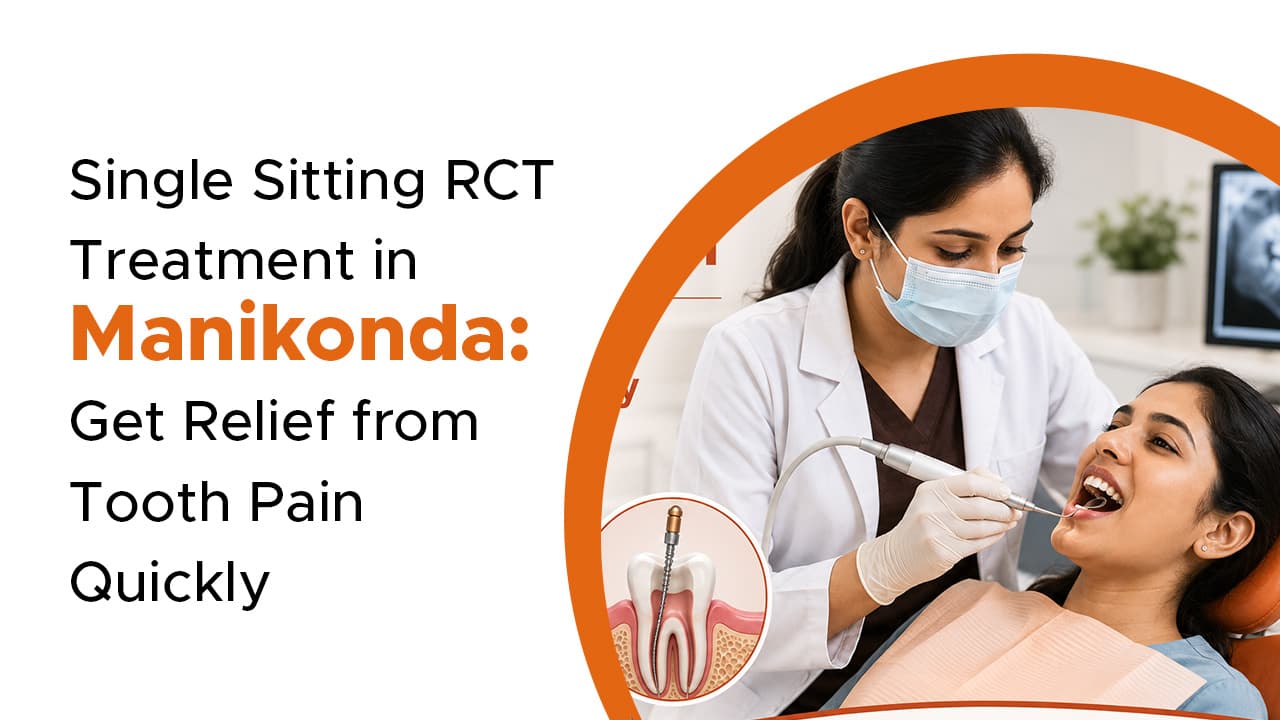
Tooth pain from a pulp infection doesn't ease up on its own. It tends to get worse especially at night, when pressure builds inside the tooth and there's nothing to distract from it.
For suitable cases, single sitting root canal treatment completes the entire procedure in one appointment, the infected pulp is removed, the canals are cleaned and sealed, and you leave the same day.
At Eledent Dental Hospital, pain relief in most cases begins within 24 to 48 hours as the post-procedure inflammation settles. With 19+ years of experience and over 30,000 teeth saved the endodontists, specialists in pulp and root canal treatment assess each case before confirming whether single sitting is the right approach.
This blog by our experts covers how single sitting RCT works, how it relieves pain quickly, which cases it suits and what it costs in Manikonda.
What is Single Sitting RCT and How is it Different from Traditional Root Canal Treatment?
Root canal treatment also called RCT or endodontic treatment is a procedure used to save a tooth when the inner pulp, the nerve and blood supply at the centre of the tooth, becomes infected or irreversibly inflamed. The pulp is removed, the canals are cleaned, shaped, and disinfected, and the tooth is sealed to prevent reinfection.
In traditional multi-visit
root canal treatment in Manikonda, this happens across two to three appointments.
- The dentist cleans the canals in the first visit
- Places a medicated dressing inside the tooth
- Seals it temporarily, and completes the final filling of the canals in a second or third visit.
Single sitting RCT compresses all of this into one appointment. Access, cleaning, shaping, disinfection, and obturation all happen in the same session.
- No temporary dressing.
- No return visit for the final seal.
How Does Single Sitting RCT Relieve Tooth Pain So Quickly?
The pain from a pulp infection comes from pressure and inflammation inside the tooth. The infected pulp has nowhere to go, and the body's inflammatory response adds to it. Once the pulp is removed and the canals are cleaned and sealed, that source is gone.
The
painless root canal treatment in Hyderabad itself is done under local anaesthesia so you won't feel it during the appointment. Afterwards, mild soreness around the tooth for one to two days is normal as the surrounding tissue recovers.
Which Cases Are Suitable for Single Sitting RCT and Which Are Not?
Single sitting RCT isn't the right approach for every infected tooth. The endodontist confirms suitability after examining the tooth and reviewing the X-ray. Here's what determines the decision:
When Single Sitting RCT Is the Right Call?
- The pulp is inflamed but the infection is contained, no severe abscess or active drainage.
- The tooth has single or clearly visible multi-canal teeth
- The canals are accessible and can be fully cleaned and dried in one session
- The patient has no active systemic conditions that would affect healing
- There's no fluid discharge from inside the canal that requires staged management
|
Single Sitting RCT |
Multiple Visit RCT |
| Case type |
Contained infection, vital or necrotic pulp without active drainage |
Severe abscess, complex anatomy, persistent exudate |
| Visits |
1 |
2–3 |
| Between visits |
Nothing |
Medicated dressing placed, temporary seal |
| Risk of reinfection |
No temporary seal to leak |
Higher if temporary seal fails between visits |
| Patient anxiety |
Lower |
Higher, repeated anesthesia, multiple appointments |
| Suitability |
Confirmed after examination |
Confirmed after examination |
Single sitting RCT isn't a decision made over the phone or from a description of symptoms. Whether single sitting is appropriate for your case is confirmed at the appointment after the X-ray.
What Are the Benefits of Single Sitting RCT?
For cases where it's clinically appropriate, single sitting
root canal treatment in Hyderabad offers real advantages over the traditional multi-visit approach:
- One anaesthesia session : No repeated injections across multiple appointments
- No temporary dressing : Eliminates the risk of reinfection through a leaking interim seal between visits
- Less time away from work or daily routine : One appointment instead of two or three, spread across weeks
- Immediate pain source removed : The infected pulp is cleared in the same session; there's no waiting period before the final seal
- Lower inter-appointment anxiety : Many patients find the anticipation between visits harder than the procedure itself.
Remember, a single sitting approach applied to the wrong case doesn't improve outcomes; it compromises them. That's why the examination comes before the decision.
What Does Root Canal Treatment in Manikonda Cost and What Comes After?
Affordable root canal treatment in Manikonda starts from around ₹3,500 for a front tooth and goes up to ₹12,000 for a molar. The difference comes down to which tooth, how many canals, and how complex the case is. At
Eledent Manikonda, the exact cost is confirmed after the endodontist examines the tooth and reviews the X-ray.
| Tooth type |
Canals |
Indicative RCT cost range |
| Front tooth (incisor/canine) |
1 |
₹3,500 – ₹6,500 |
| Premolar |
1–2 |
₹4,500 – ₹8,000 |
| Molar |
3–4 |
₹6,000 – ₹12,000 |
What Changes the Cost?
- Number of Canals : Molars have more canals than front teeth; each canal adds to the time and precision
- Infection Severity : A more complex infection may require additional irrigants, more time.
- Microscopic Endodontics : Used when canal anatomy demands higher magnification; adds to precision and may affect cost.
- Crown after RCT : Quoted separately; the crown protects the treated tooth from cracking under bite force

How Does Eledent Dental Hospital Offer Single Sitting RCT in Manikonda?
Single sitting RCT is technically demanding. Completing access, cleaning, shaping, drying, and obturation in one session accurately, without compromising the seal requires specific instruments, clinical skill, and the ability to assess the case correctly before committing to the approach.
At Eledent Dental Hospitals, root canal cases are handled by endodontists, not general dentists handling RCT alongside routine work. The Manikonda branch uses rotary endodontic instruments for canal preparation, an apex locator for precise canal length measurement, andmicroscopic dentistry capability for cases where the canals are narrow, curved, or difficult to locate under standard magnification.
Patients from Manikonda, Narsingi, Khajaguda, Puppalguda and Toli Chowki visit the
Eledent Dental Hospitals for root canal treatment. The branch is open Monday to Sunday, 9 AM to 9 PM. NABH accreditation covers sterilisation, infection control, and clinical protocols at the branch; the same standard is applied at every Eledent location across Hyderabad.
Get Your Tooth Examined at Eledent Dental Hospitals Today.
If you're in pain or if you've been putting off a tooth that's been bothering you for weeks come in for an assessment. The endodontist will examine the tooth, take an X-ray, and tell you clearly whether single sitting RCT is the right approach for your case.
Call
+91 77996 59994 to book your appointment.
Frequently Asked Questions
Is single sitting RCT painful?
The procedure is done under local anaesthesia, so you won't feel pain during the appointment.
Mild soreness for a day or two after the treatment is normal.
How quickly does tooth pain go after a single sitting RCT?
The deep, pressure-driven pain from the infection typically resolves within 24 to 48 hours.
Some tenderness around the tooth for a day or two after the procedure is normal and usually settles on its own.
Do I need a crown after a single sitting RCT?
For premolars and molars, a crown is generally recommended after RCT. The treated tooth may be structurally weakened
and can be at risk of fracturing under chewing pressure without proper restoration.
Is a single sitting RCT more expensive than a traditional RCT?
In most cases, the cost is comparable. A single sitting RCT may carry a marginally higher charge due to the
instruments and time involved in completing the procedure in one session, but it can save the time and cost
associated with returning for additional appointments.